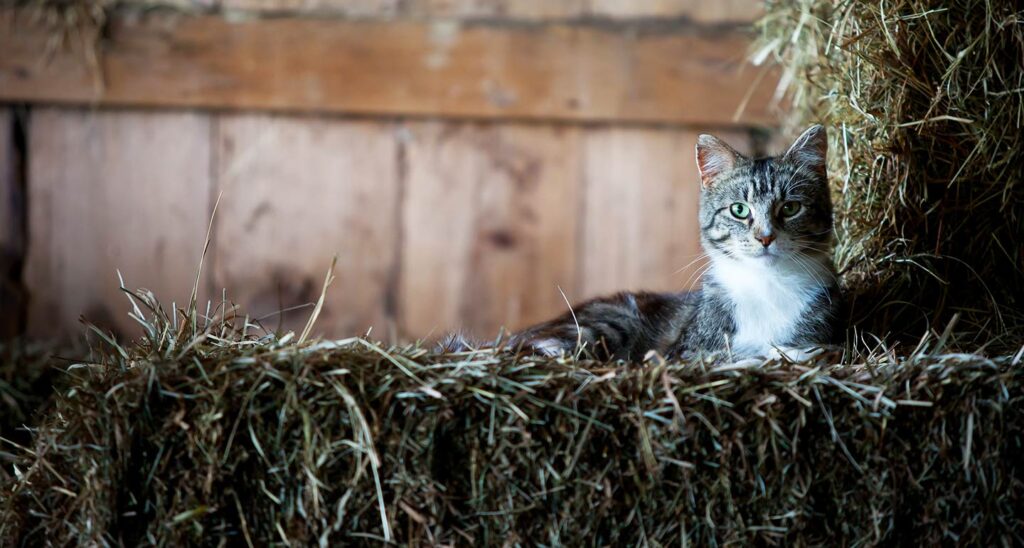
When you think of a pet cat, you might imagine a snuggly furball weaving between your legs or cozying up with you on the couch during TV time. But some cats are simply not meant to be domesticated. “Feral cats or semi-feral cats would not be happy in a house,” explains Leah Enderle, program and marketing coordinator for Tails Humane Society in DeKalb, Illinois. “It would be like taking a raccoon from outside that’s lived its whole life there, and trying to make it sit in your lap.” It’s often equally dangerous to leave a homeless cat on the street. There’s little support for the health and safety of feral and semi-feral cats, who often live in dangerous or abandoned environments, explains Theresa Samsingh Bachu, founder of For Animals in New York City. And for too many “unadoptable” cats, entering a shelter can lead to euthanasia. That’s where working cats programs come in. They give so-called “unadoptable” cats a second (or perhaps third and fourth chance) at a healthy, stable life by placing them in homes with plenty of room and a purpose. For cats displaying behaviors like biting and scratching, oftentimes “the best way to get them to calm down is give them a job,” explains Erica Leonard, community animal welfare specialist and working cat coordinator for MSPCA-Angell at Nevins Farm in Methuen, Massachusetts. “Usually, that job is hunting or just patrolling the property. Cats are hunters and they’re natural predators.” “If we go back to the traditional sense of why cats were domesticated in the first place, it was because they helped farmers with their rodent population and in turn, they were given shelter,” explains Melissa Graham, CFTBS, feline welfare specialist at Arizona Humane Society, which “employs” two working cats of its own, Simba and Nala, for pest control at one of the society’s properties. “As we grew alongside our feline friends, cats changed in shape and color, but they never really got rid of their hunting instincts.”,Leah Cullen had always thought of herself as a dog person. But when she went searching for a solution to a pesky mole problem on her acre of land in Western Pennsylvania earlier this year, she gained a whole new appreciation for felines—and working cats in particular. Cullen’s search led her to the working cats program at the Humane Animal Rescue in Pittsburgh, Pennsylvania, which places feral, semi-feral and so-called “difficult” cats in nontraditional homes like farms, ranches and other large plots of land. The cats provide pest control, and in exchange, they get to live in an environment better suited to their independent personalities. Today, Cullen is a proud parent to two cats, Lucy and Linus (named, of course, after the Peanuts characters). Not only have they successfully battled the pests on her property, but they’ve found a place in her home and in her heart. “I wasn’t sure what I was getting into, but they’ve been the best part of 2020,” Cullen says. Cullen says her cats have changed her perspective on what a pet can be— and she’s not alone. More than 13,200 working cats have found free-range homes in 2020, and many programs have long waitlists to adopt these uniquely helpful pets, according to data from Shelter Animals Count. Working cats provide a valuable service to pet parents, and in return, their parents provide them with love, care and a safe and spacious home—an especially meaningful exchange for cats who have nowhere else to turn.