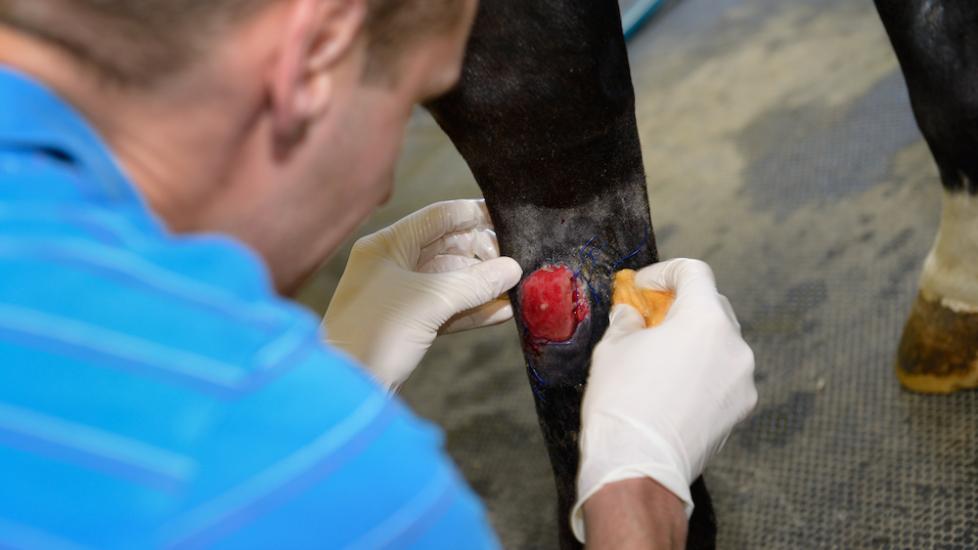
Recovery and Management of Proud Flesh in Horses It may take a couple of weeks to several months to recover from proud flesh, depending on the severity of the tissue overproduction and the size of the wound. Frequent rechecks with your veterinarian are critical to the best possible outcome. The goal is to keep the granulation tissue from becoming over-productive while new skin cells are being produced and are growing over the wound. If the area of proud flesh is small and not in a highly mobile area of skin, the horse may undergo light exercise, but should not be turned out unattended. If they have a large area of proud flesh that is in a highly mobile area or a cast, they should be on stall rest and taken for several 10–20 minute walks per day on a lead. These daily walks are recommended to help prevent colic. Since the horses should not be running around during recovery, it is important to provide them with things to keep them from getting bored and becoming destructive. Examples may include hiding treats in their stall or giving them a jolly ball to play with. Prevention of Proud Flesh in Horses The best way to treat proud flesh is to prevent it from occurring. The best way to prevent proud flesh is to close any wounds by suturing the skin edges closed. Unfortunately, due to the nature of some horse wounds, this may not be possible. Additionally, even when the skin is sutured together, there is always the possibility that the closure will fail. This can be due to movement, inflammation in the horse’s tissues, or infection. With time and careful attention to how your horse’s wound is healing, recovery from proud flesh has a good prognosis. Featured Image: Adobe/Reimar,References Cable, Christina. Ball, Mike. AAEP. Proud Flesh | AAEP. Haspel, Allison. AAEP. Understanding Proud Flesh | AAEP. Schumacher J. Tips for Managing Horses with Wounds of the Distal Portion of the Limb. 2019. Welker F. Basics of Wound Healing: Predicting the Future. Western Veterinary Conference. 2013.,What Is Proud Flesh in Horses? Proud flesh is the overproduction of granulation tissue in a horse. Granulation tissue is the material that the body makes during wound repair. Medically, this condition is known as “exuberant granulation tissue.” It is recognized by its red, bumpy, cobblestone appearance. Proud flesh is a very common condition in horses–occurring most often on the horse’s legs, below the knee and hock. Full skin thickness wounds that have not been closed with sutures and are left to heal on their own are at risk of developing proud flesh. Wounds on your horse should be addressed with urgency. Any wound over a joint or tendon constitutes an emergency. For optimal healing, wounds should be sutured closed within eight hours of their occurrence.